
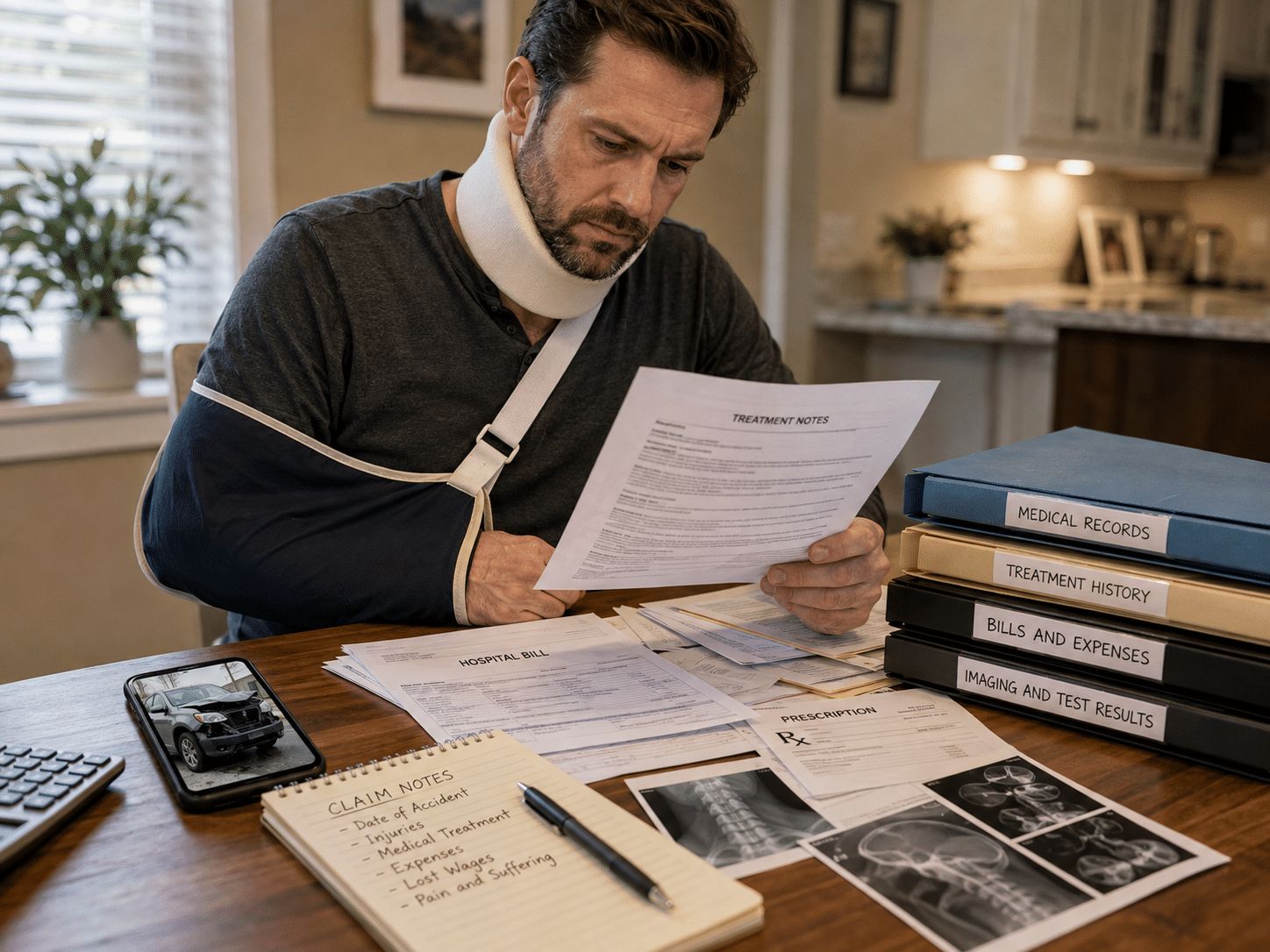
After a serious car accident in Schaumburg, medical records often become key evidence in an injury claim. While a crash on a busy road like Interstate 90 or Roselle Road can happen in seconds, proving the physical effects may take months of medical documentation. Insurance companies look beyond whether an accident happened. They want to see if the medical records link the crash to the injuries, if treatment was consistent, if the injuries improved, and if more care might be needed. When I help someone injured in Schaumburg or nearby, I focus on the medical records because they often explain the injury better than photos or accident reports.
Medical records can influence whether an insurance company accepts an injury claim and how much it offers to pay. Records from the emergency room, imaging tests, orthopedic visits, physical therapy, surgeries, pain management, and follow-up appointments can all play a big role in the settlement process. On the other hand, inconsistencies, unexplained gaps in treatment, similar past complaints, or records that do not match a patient’s symptoms can give the insurer reasons to challenge the claim. Knowing how these records are reviewed helps explain why medical documentation is so important in Illinois car accident settlements.
Medical Records Help Establish The Connection Between The Crash And The Injury
One of the first things an insurance company looks at is what caused the injuries. They might agree their policyholder caused the accident but still question if all the injuries were actually from the crash. Medical records can help show the timeline from the accident to when symptoms started, how the injury was diagnosed, the treatment given, and the recovery process.
For example, if someone is rear-ended in Schaumburg and starts having neck pain, headaches, and pain down their arm, an emergency room record showing those symptoms soon after the crash can be very important. If later tests find a cervical disc injury and a doctor links the symptoms to that injury, the medical history becomes clearer. Physical therapy notes can show ongoing problems, and later checkups can reveal if the condition is getting better or turning into a long-term issue.
A well-documented sequence of medical care can make it considerably more difficult for an insurance carrier to argue that an injury appeared unexpectedly months after an accident.
The Timing Of Medical Treatment Can Affect A Settlement
Insurance companies routinely examine when an injured person first received treatment. They may argue that someone who waited several weeks before seeing a physician could not have been seriously injured. That argument does not necessarily reflect reality. Some injuries produce delayed symptoms, and accident victims sometimes hope soreness will disappear without treatment.
Still, waiting a long time before getting treatment can raise questions that need to be answered. The insurance company might ask what happened between the accident and the first doctor visit. They could suggest that something else caused the problem or that the injury was not as serious as claimed.
That is why I tell injured people to take their symptoms seriously. Getting the right medical care is most important for your health, but it also creates records that show when symptoms started, how bad they were, and how they affected your daily life.
Treatment Gaps Can Become A Major Insurance Issue
A gap in treatment happens when someone starts getting medical care but then stops going to appointments for a while before starting again. Insurance adjusters often pay close attention to these gaps.
The insurance company might argue that if you stopped treatment, your injury must have healed. If you start treatment again later, they may say the new symptoms came from something other than the original accident.
There can be legitimate reasons for a treatment interruption. Someone may lose health insurance, be unable to miss work, have transportation difficulties, struggle to obtain a specialist appointment, or be instructed by a physician to wait before returning. Those circumstances matter.
Problems come up when there is a gap in treatment with no clear reason. Medical records and other documents can help show why treatment stopped and if symptoms continued during that time.
Diagnostic Testing Can Provide Important Objective Evidence
Certain injuries are difficult to establish based solely on a patient’s description of pain. Diagnostic studies can therefore become highly important in a car accident claim.
X-rays may identify fractures or structural abnormalities. MRI studies may reveal herniated discs, ligament damage, rotator cuff tears, labral injuries, and other soft tissue conditions. CT scans can detect fractures, internal injuries, and certain traumatic brain injuries. Electromyography and nerve conduction studies may help evaluate nerve damage.
An imaging finding does not automatically determine the value of a settlement. The finding must still be considered with the symptoms, physical examination, prior medical history, treatment, and physician opinions.
The strongest medical evidence often comes from the complete clinical picture rather than a single test result.
Prior Medical Conditions Do Not Automatically Defeat A Claim
Many people involved in Illinois car accidents already have some type of medical history. Someone may have experienced occasional back pain, arthritis, degenerative disc disease, an old shoulder injury, or treatment from an earlier accident.
Insurance companies commonly obtain prior records and compare them with post-accident records. They may argue that the current complaints existed before the crash.
A prior condition does not automatically eliminate the possibility of compensation. A collision can aggravate or worsen an existing physical condition. The important question becomes how the person’s condition changed because of the accident.
That comparison may require reviewing records from before and after the collision. If a person previously had mild occasional back discomfort but after the accident requires injections, extensive therapy, or surgery, that change can be highly significant.
Medical Records Can Show How An Injury Affects Daily Life
Settlement value is not based exclusively on the name of an injury. Two people may have the same diagnosis but experience dramatically different consequences.
Medical records can describe difficulty walking, lifting, sleeping, driving, working, exercising, or completing ordinary household responsibilities. Physical therapy notes may document reduced range of motion, weakness, balance problems, or difficulty completing exercises. Orthopedic records may impose lifting restrictions or work limitations.
Those details can help demonstrate that an injury is affecting more than a single body part. They help show how the condition interferes with normal life.
This documentation becomes particularly important when pain and limitations continue for months.
Future Medical Treatment Can Increase The Value Of A Claim
Some injuries eventually resolve. Others require continuing treatment long after settlement negotiations begin.
A physician may recommend additional physical therapy, injections, pain management, surgery, follow-up imaging, or long-term monitoring. When future treatment is reasonably expected, those anticipated costs may become part of the damages analysis.
This can be especially important in cases involving spinal injuries, traumatic brain injuries, serious fractures, shoulder injuries, knee injuries, and conditions requiring surgery.
Settling before the long-term medical picture is clear can create serious problems. Once a claim is fully settled and released, an injured person generally cannot return to the insurance carrier later simply because additional treatment became necessary.
Medical Bills Matter, But They Are Not The Whole Case
Medical expenses are an important component of many Illinois accident claims, but the amount billed does not tell the entire story.
An injury claim may also involve lost wages, reduced earning ability, pain, physical limitations, disability, and other losses. The medical documentation helps provide context for those damages.
A relatively modest amount of medical treatment can sometimes accompany a serious permanent injury. Conversely, substantial medical billing does not automatically guarantee a large settlement if the insurer disputes whether treatment was necessary or related to the accident.
I look at the medical evidence as part of the complete damages picture rather than treating the total amount of bills as the sole measure of case value.
Insurance Companies May Search The Records For Inconsistencies
Insurance carriers do not review medical records only to confirm injuries. They also look for statements that may support arguments for reducing the claim.
A record might incorrectly state that an injury occurred before the accident. Another note might say a patient is “doing better,” even though the improvement is only temporary. A medical history may omit a symptom that was discussed but not documented. Prior medical records may contain similar complaints.
These issues do not necessarily destroy a case, but they need to be understood before settlement negotiations begin.
This is why careful review of the complete medical history can be so important. I want to know which portions of the record strengthen the claim and which portions the insurance company is likely to challenge before those arguments appear in a settlement response.
Illinois Law Gives Patients Access To Their Health Care Records
Illinois law provides a mechanism for patients and properly authorized representatives to inspect and obtain health care records. Under 735 ILCS 5/8-2001, health care facilities and practitioners generally must permit patients, authorized attorneys, and others presenting valid authorization to examine and obtain copies of qualifying patient records.
Obtaining a complete medical file can involve much more than collecting a few bills. The records may include histories, physician notes, imaging reports, therapy documentation, surgical reports, discharge instructions, and other information generated during treatment.
These materials can help establish the chronology of an injury claim and identify issues that should be addressed before a demand is submitted to an insurance company.
Medical Documentation Becomes Even More Important If A Lawsuit Is Filed
Many car accident cases settle without trial, but settlement negotiations are still influenced by what evidence could ultimately be presented if litigation becomes necessary.
Illinois Rule of Evidence 803(6) recognizes a hearsay exception for qualifying records of regularly conducted activity, subject to the rule’s requirements regarding preparation and trustworthiness. Medical documentation therefore can play a significant evidentiary role when properly established during litigation.
The possibility of litigation is one reason I evaluate medical records as potential evidence rather than simply paperwork used to calculate medical expenses.
A strong settlement presentation should help an insurer understand what the evidence could show if the dispute progresses further.
Waiting Too Long Can Create Problems Beyond The Medical Records
Illinois generally requires an action for personal injury damages to be commenced within two years after the cause of action accrues under 735 ILCS 5/13-202, although different rules and exceptions can apply in particular circumstances.
That deadline is separate from the practical problem of disappearing evidence. Medical memories become less precise, witnesses become harder to locate, records take time to gather, and insurers may challenge lengthy unexplained delays.
For someone injured in Schaumburg or another Illinois community, addressing the claim early can allow medical evidence, accident evidence, and insurance information to be evaluated together rather than waiting until a deadline is approaching.
Speak With A Schaumburg Personal Injury Attorney About Your Car Accident Claim
Medical records can have a major effect on the outcome of a car accident claim because they help establish what injuries occurred, when symptoms developed, what treatment became necessary, and whether the collision caused lasting physical limitations. Insurance companies know this and often scrutinize those records for treatment gaps, prior conditions, inconsistent statements, or other information they can use to reduce a settlement. I believe those issues should be identified and addressed before an insurance carrier is allowed to define the value of an injury claim based on an incomplete picture.
At SJ INJURY LAW, I represent people injured in motor vehicle accidents throughout Schaumburg, Chicago, and communities across Illinois. If a crash has caused serious injuries, I can review the medical evidence, investigate the collision, evaluate the insurance coverage, document the financial and physical losses, and pursue compensation from the responsible parties.
If you were injured in Schaumburg, Arlington Heights, Buffalo Grove, Des Plaines, Mount Prospect, Northbrook, Palatine, Prospect Heights, Wheeling, Park Ridge, Rosemont, Glenview, Chicago, or anywhere in Illinois, call our Schaumburg car accident injury lawyer at SJ INJURY LAW by calling (847) 434-3555 to receive your free consultation. The sooner I understand the medical history and circumstances surrounding the collision, the sooner I can identify the issues that may affect the value of the claim.